Two years ago crews punched holes in three dams on the Klamath River in northern California and southern Oregon. Waters held back for decades rushed free. It wasn’t pretty: For weeks, a river of chocolate milk cut through a raw, monotone landscape of glistening, sticky mud. The dams were removed later in 2024, reconnecting the vast Klamath watershed and opening up hundreds of miles of prime habitat for salmon and other anadromous fish.
Resource Environmental Solutions, or RES, with help from Tribal partners, has taken on the challenge of revegetating the three reservoir footprints — 2,200 acres in all — with native seeds and plants.
Early that first spring, before the dams had even been completely removed, crews left cryptic tracks in the mud as they spread seed and planted acorns by hand. Helicopters rained seed from the sky and lofted entire trees, destined for tributary creeks, through the air.
Soon the first hints of renewal appeared: the green fuzz of young vegetation; a fringe of willows along the riverbank. In summer poppies bloomed, a glorious sea of gold.
Two years after drawdown, the planting, seeding, and sculpting continue.
“This is certainly not a set-it-and-forget-it project,” says Dave Coffman, RES’ director of Northern California and Southern Oregon operations. “We’re going to steward this landscape for at least the next five years, because that’s what it takes to start to see a landscape recover.”
Dam removal on the Klamath was simply the first, albeit most dramatic, step.
Replanting an Ecosystem
How do you obtain 20 billion seeds, anyway?
Through a process called amplification. Tribal crews started collecting native seeds from near the reservoirs well before drawdown. Most were taken to nurseries and planted in pots or fields where they could grow to maturity and produce exponentially more seeds themselves.
Native seeds are typically tiny, measured by weight rather than numbers. Special seed mixes are tailored for each of the reservoir footprints; last fall alone, each footprint received between 6,000 and 8,000 pounds of seed.
Over the winter months, crews have been planting about 60,000 bare-root trees and shrubs in the ground by hand. Coordinating this massive project in the sprawling, remote country is a feat in itself.
“There’s a lot of rolling tires,” says Will Bowers, restoration manager at RES and a Yurok Tribal member. “You want to get the plants in before the springtime so they’re set up and the roots are growing.”
Among many other species, the palette of native vegetation includes Oregon grape, rabbit brush, ponderosa pine, and several species of oaks. Crews are also planting tens of thousands of acorns directly in the ground.
“If we plant 10 acorns and five of them germinate and one of them makes it to maturity, the input cost of doing that is substantially lower than gathering, sowing, growing, transporting, and transplanting a potted plant,” says Coffman.
Before and after photos of former Copco Reservoir at Beaver Creek (photos: RES).
There have been challenges, among them keeping nonnative, potentially invasive plant or fungi species at bay. (There’s no more depressing sight than a dust devil full of Medusahead seeds, says Coffman). Over the past two years, they’ve rejected thousands of nursery-grown plants because they tested positive for Phytophthora ramorum, the same fungal organism that causes sudden oak death.
At J.C. Boyle, the most upstream of the former reservoirs, young plants weren’t thriving because loads of decomposing algae had acidified the soil. Crews have applied limestone and reseeded this area.
Springtime is when you can see the seams of the ecosystem starting to stitch back together, says Bowers.
“Everything’s in bloom, everything’s green, there’s water in the creeks and it just brings lightness to your heart,” he says.
Setting the Table for Fish
Bowers was 10 years old in 2002 when a devastating fish kill ravaged the fall Chinook run on the Lower Klamath River. He remembers dead fish washing up on the banks near his family’s fishing cabin. Now, immersed in restoration work, he relishes signs of the river’s healing.
“I was driving to Jenny Creek and all of a sudden I saw this bald eagle fly up on top of this hill and it had a salmon in its mouth and it was picking away on it,” says Bowers. “It was kind of like, oh man, we’re there.”
Though the restoration of the Klamath watershed will benefit species from bees to beavers, a key aim is to save struggling salmon and steelhead runs.
Tributaries like Jenny Creek, which flows into the Klamath River a mile upstream of the old Iron Gate dam, are crucial habitat. For this reason RES has spearheaded work on Jenny Creek and several other tributaries where they join the main stem Klamath — confluences that for decades were submerged under the dam reservoirs.
Yurok Tribe Construction Corporation and the Yurok Tribe Fisheries Department Technical Service Program have taken on the bulk of the on-the-ground work.
To enhance habitat, crews have placed “large wood” — entire trees, flown in by helicopter — in the newly unbound creeks. The logs help create pools and riffles that salmon prefer; the shady spots underneath also make good hiding places.
Another aim is to sculpt the banks and connect them to the floodplain, which allows for “resource trading,” says Coffman.
“You get fish food washed off the floodplain and into the stream, and during high flows sediment is deposited in the floodplain.”
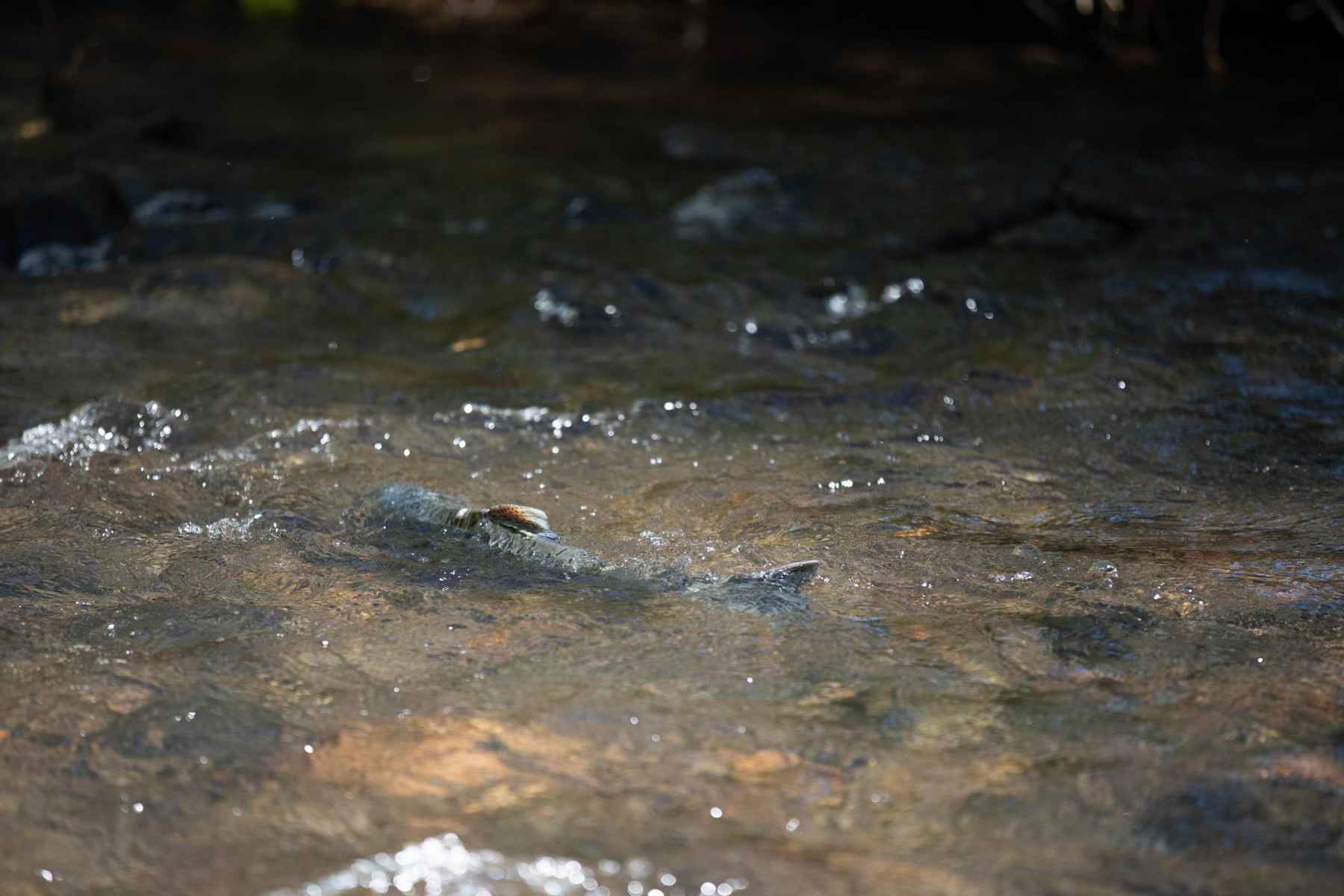
The table-setting on these creeks was still in progress when fish crashed the party. In October of 2024, mere weeks after the completion of dam removal, fall Chinook salmon stunned biologists, immediately exploring tributaries they hadn’t accessed in over 100 years.
This past fall pioneering fish ventured even farther into the watershed. Chinook were “everywhere,” according to agency biologists.
“The speed at which salmon are repopulating every nook and cranny of suitable habitat upstream of the dams in the Klamath Basin is both remarkable and thrilling,” said Michael Harris, environmental program manager of California Department of Fish and Wildlife, in a press release.
Last fall biologists counted over 10,000 adult fish, mostly Chinook, passing by the former Iron Gate dam site — 30% more than the year before. Fish also returned earlier in the season.
Every bit of reclaimed habitat gives spawning salmon more options. For this reason, Trout Unlimited and a slew of partners demolished a small concrete dam about a mile up Jenny Creek, opening up another mile of stream habitat.
Rearing habitat is just as critical as creating places where fish can spawn. Lower down on Jenny Creek, they’ve dug a new pond right next to the flowing stream — a place where young fish can hang out and chill, especially when the region turns frying-pan hot in summer.
Fish in these ponds regularly grow 1-2 inches (3-5 centimeters) bigger than juveniles who don’t have access to them, says Bowers.
Work will continue for years, removing small barriers, enhancing habitat, and monitoring the work that has been done.
Before Bowers took the job with RES, he led planting crews along tributary creeks for the Yurok Tribe Construction Corporation. During spawning season, he would urge his planters to take a break and walk down to the water’s edge.
“When we did that, we would see 15 to 20 salmon in the creek swimming,” says Bowers. “That was the one point I always wanted to make. This is why we do it right here.”
This story originally appeared in The Revelator and is part of Covering Climate Now, a global journalism collaboration strengthening coverage of the climate story.
Trending Products