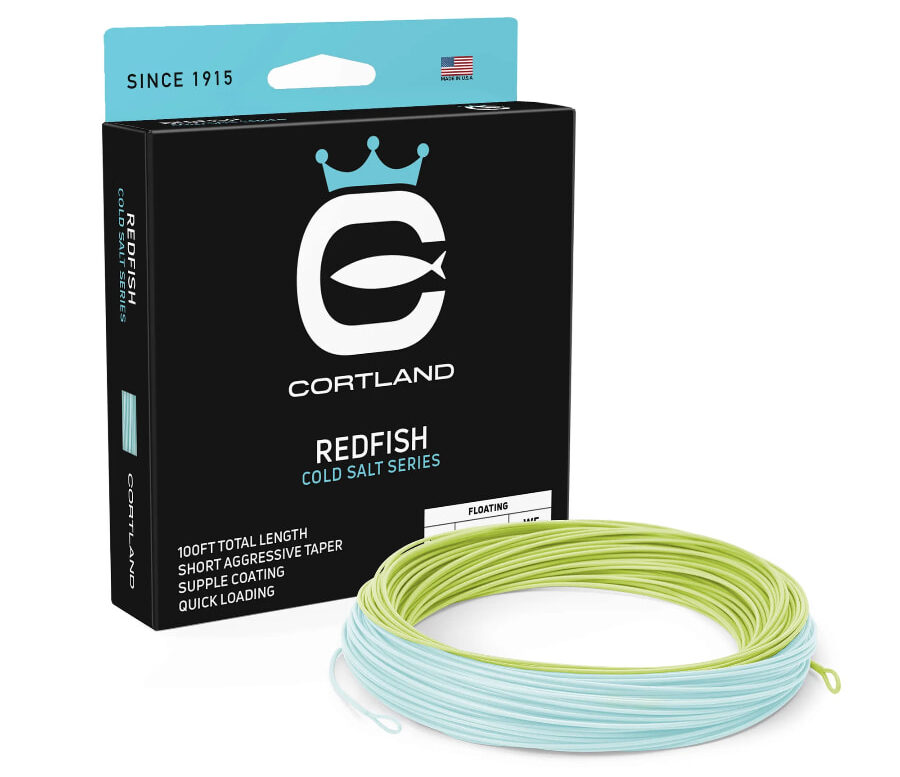
Cortland’s Cold Salt series of fly lines has mastered the melding of supple and tough.
For decades, fly fishing manufacturers sold gear with broad, all-weather promises. A fly line was “versatile.” A floatant “worked great.” A leader was “strong.” But in 2026, the industry appears to have crossed a threshold—and the anglers who fish through winter’s tightest windows are the ones benefiting most.
Across fly lines, terminal tackle, weighting systems, and even floatants, this year’s gear landscape reflects a deliberate shift toward what might be called “conditions-first” engineering: formulations, materials, and designs built not just for the river in general but for the specific, unforgiving demands of cold water, tiny flies, and the subtle presentations they require.
Fly Lines That Actually Behave in the Cold
The idea that a fly line should perform differently at 38°F than at 68°F isn’t new, but the execution has become markedly more sophisticated. Scientific Anglers continues to refine its long-running Mastery series, where cores and coatings are specifically calibrated for stated temperature ranges. The company’s AST (Advanced Shooting Technology) additive provides friction-reducing slickness and helps lines shed dirt and microparticles that create drag — a meaningful advantage when cold, stiff conditions demand every ounce of casting efficiency. Their Mastery Trout line, for instance, is explicitly designed for cold-to-moderate climates and features a revised compound taper aimed at delicate deliveries with small flies — exactly the kind of presentations winter tailwater anglers depend on.
Meanwhile, RIO Products has doubled down on its SlickCast coating technology, which the company has described as the lowest-friction fly line surface ever measured. Independent testing by shops and review outlets has broadly supported the claim: RIO’s lab data indicates SlickCast lines require roughly 49% less pulling force through guides than their nearest competitor and show dramatically improved abrasion resistance. That reduced friction translates directly into smoother shooting, better loop formation, and easier line management—attributes that matter most when cold hands, heavy gloves, and short casting windows compress every advantage. SlickCast now appears across RIO’s Elite and Premier tiers in popular tapers including the Gold, Grand, Technical Trout, and Perception lines, all paired with ConnectCore Plus for improved strike sensitivity.
The practical upshot is that anglers heading out in February no longer need to accept a line that coils like a phone cord or refuses to shoot. Temperature-specific engineering has moved from a luxury niche into the mainstream product line.
Terminal Tackle Goes Thinner, Clearer, Lighter
The broader terminal tackle market is trending toward thinner, clearer materials optimized for minimal drag and improved turnover—a shift that aligns perfectly with the demands of cold-weather, small-fly fishing. Fluorocarbon tippets, with their near-invisible refractive index in water and natural sinking properties, have become the default for subsurface presentations targeting pressured trout. Manufacturers like Cortland, Orvis (with its Mirage fluorocarbon line), and Hatch Outdoors are producing tippet materials with increasingly consistent diameters and high strength-to-thickness ratios, allowing anglers to drop to 6X or 7X without sacrificing durability.
The appeal is straightforward: in the clear, low flows typical of winter tailwaters, fish see everything. A thinner tippet means less visible connection to the fly, less micro-drag on a dead drift, and better energy transfer to turn over the size 20–24 midges and Blue-Winged Olives that dominate cold-water hatches. Competition-style anglers, who have long pushed the limits of fine terminal tackle, are driving much of this demand — and the equipment is catching up. Lightweight fluorocarbon leaders, micro-diameter braids for Euro-nymphing sighter sections, and tippet rings that allow rapid changes without shortening leaders have all become standard fare rather than specialty items.
While no single brand has made a splashy 2026 press announcement about a revolutionary micro-tippet product, the cumulative effect is clear: the terminal-tackle ecosystem has quietly reorganized itself around the principle that less material between line and fly means more fish.
Tungsten Putty and the Art of Micro-Depth Control
One of the less glamorous but most practically significant developments in cold-weather fly fishing tackle is the continued rise of moldable tungsten putty as a weighting system. Products like Loon Outdoors’ Deep Soft Weight — a non-toxic, tungsten-based putty that can be pinched onto a leader, repositioned, and reused indefinitely — have been around for years. But their popularity has surged as more anglers recognize the limitations of traditional split shot in delicate winter presentations.
The logic is simple: when you’re fishing size 22 Zebra Midges on 6X tippet in 40°F water, the difference between drifting six inches too high and being in the strike zone can be the difference between a blank day and a dozen hookups. Tungsten putty lets anglers add or subtract weight in tiny increments, sculpt it into streamlined shapes that minimize hang-ups, and mold it over knots where it stays put. It doesn’t crimp tippet the way pinch-on shot can, and its density — tungsten is significantly heavier than lead by volume — means a small amount goes a long way.
The broader fishing tackle market has also seen a proliferation of tungsten shot variants and adaptable weight systems designed around the same principle: fine-tuned, repositionable depth control that doesn’t compromise a natural drift. For the cold-weather angler chasing micro-depth balance with tiny flies, these systems have become indispensable.
Floatants Engineered for Real Temperatures
Perhaps nowhere is the conditions-first philosophy more evident than in modern fly floatants. The newest generation of silicone gel formulas is specifically marketed—and formulated—around temperature stability, addressing the perennial frustration of floatants that turn to brick in January or run to liquid in July.
Loon Outdoors’ Aquel, the official floatant of Fly Fishing Team USA, exemplifies the approach: it maintains a stable viscosity across extreme temperature ranges, applies smoothly even with cold fingers, and leaves no oil slick on the water. Similarly, their Lochsa gel floatant is designed not to melt in heat or harden in cold and works even on the delicate CDC (cul-de-canard) feathers common in modern dry-fly patterns. Products like Hackle Armour’s Premium Silicone Fly Floatant and RoxStar’s FLOAT-TECH gel explicitly tout cold-weather performance as a primary selling point, with formulations engineered to maintain consistent gel texture through freezing conditions.
The practical difference is real. Anyone who has tried to squeeze a tube of floatant on a 28°F morning and gotten nothing—or worse, gotten a rock-hard blob that mats the hackle of a size 22 parachute Adams—understands the problem these products are solving. A floatant that works reliably across a wide temperature range means one less variable fighting against you when conditions are already demanding maximum precision.
The Bigger Picture
What makes the 2026 gear landscape noteworthy isn’t any single breakthrough product. It’s the convergence: fly lines calibrated for specific temperature ranges, tippet materials engineered for near-invisibility at extreme diameters, weighting systems that allow gram-by-gram depth adjustment, and floatants that simply work regardless of what the thermometer reads.
Taken together, these developments reflect an industry that has stopped treating cold-weather fly fishing as an afterthought or an edge case. The anglers who brave icy guides, numb fingers, and finicky winter trout are getting gear built for the way they actually fish—and the results, measured in hookups per hour on a frigid February tailwater, speak for themselves.
The message from manufacturers is clear: conditions matter, and in 2026, the gear finally does too.
Trending Products