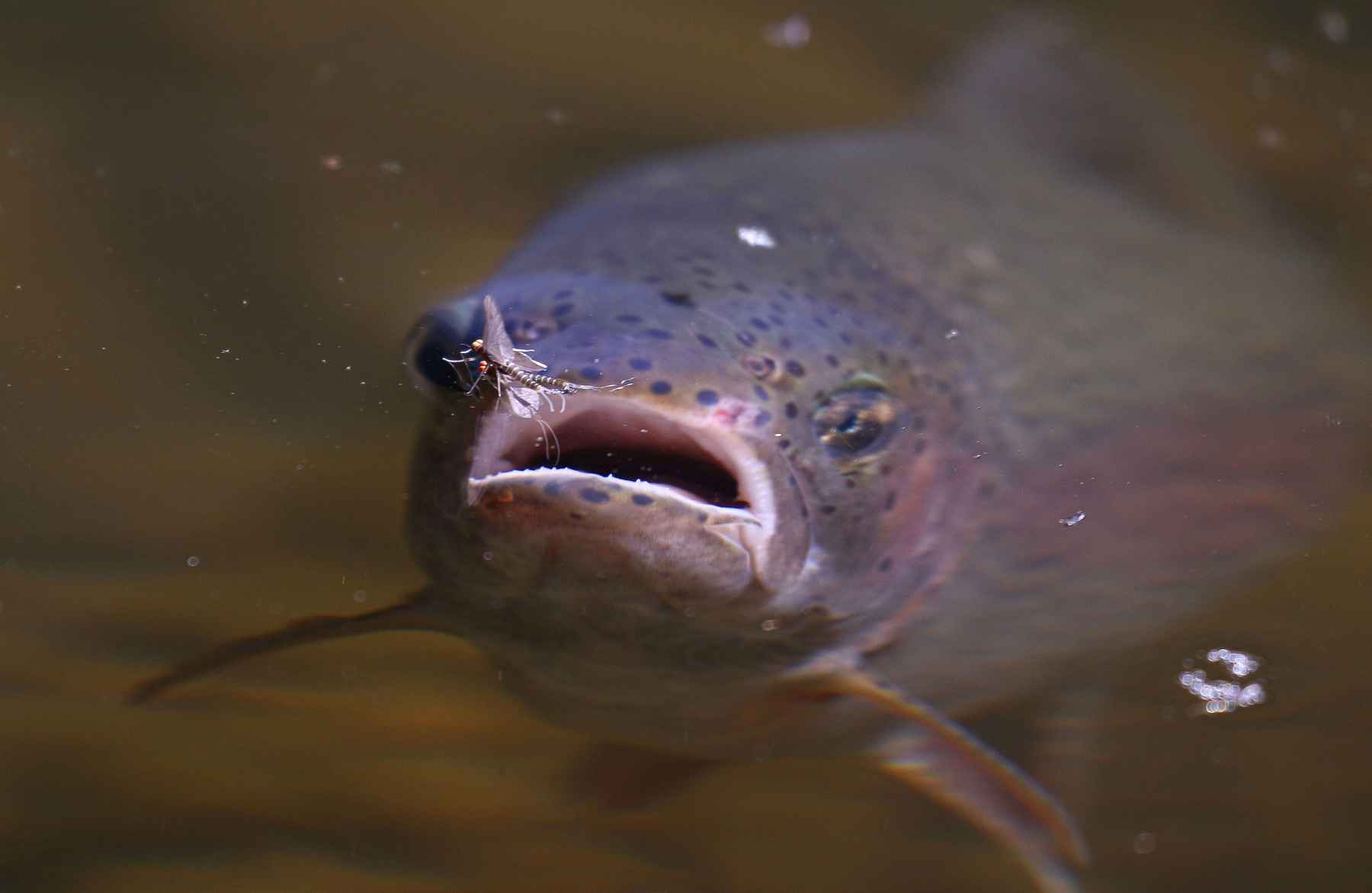
One of the most common mistakes I ran across back in my days as a fly fishing guide on the Henry’s Fork, the Yellowstone and the Madison — as well as one of the more regular problems I see when I’m teaching at the School of Trout — is that most anglers have no idea how far to lead a rising fish with their dry fly. So why does that matter, and how can we increase our odds for success?’’
The first question is the easy one. If your fly lands too close to a rising trout, it might not have time to react to your fly before your offering drifts past. Or even worse, your fly might spook the fish when it hits the water.
On the other end of the spectrum, the further upstream you cast your fly, the more likely it is that your fly will drag before it gets to your target. Drag, of course, is an absolute killer for dry fly presentations. At the same time, leading the fish by too much also diminishes the accuracy of your presentation. Even if you get a good drift, you still need to put the fly in front of the fish. The further upstream you cast, the less likely it is that your fly will float down into the trout’s feeding lane and elicit a positive response.
So what’s the answer? How far should you lead a rising trout? To be frank, nobody really knows … and that’s because every single situation is different. There are a couple of guidelines, though, that will help point you in the right direction.
Current Speed
The faster the current, the more you need to lead the fish. If your fly lands 18” in front of a trout and the water is really moving, your fly will be past the fish before it has a chance to react. The opposite also applies, of course. In slower water, you can land your fly closer to the trout — as long as your cast doesn’t spook your quarry.
Water Depth
In general, the deeper the water, the further upstream you need to cast. The fish has to see your fly, and then it has to have time to swim to the surface before it can take your fly. At the same time, the converse is also true. In shallower water, you can place your fly closer to the trout.
Fly Choice
Unless you’re fishing terrestrials — think grasshoppers — or aquatic insects that are returning to the water to lay their eggs, it’s usually better to land your fly far enough upstream that the fish doesn’t see it hit the water.
What Else?
There are a few other things you should keep in mind when you’re casting to a rising trout. First, it helps to know if your fish is stationary or moving so you know approximately where the trout is likely to rise the next time it takes something off the surface.
Second, avoid plopping your fly down right on top of the trout when you cast. More often than not, putting the cast right on a fish will spook it.
Third, landing your fly too far upstream of your target — say 15’ or 20’ — will almost always decrease your odds of success.
Which means that we’re invariably looking for a “Goldilocks” distance for our dry flies; not too close to our target, but not too far away either. While I hesitate to offer a specific range — after all, each situation is different — I typically try to put my fly 2’ to 5’ upstream of a rising fish. Could I go to 18”? Sure, if a trout is taking emerging mayflies in very slow, shallow water and if leading the fish by 3’ would substantially raise my risk of drag, I might go to 18”. Or on the other end of the spectrum, if trout are rising through deep, fast water to eat big stones or terrestrials, I might lead them by 8’ or 10’. That would be pretty extreme, though. Most of the time, in normal fishing conditions, I’m trying to lead a rising trout by 2’ to 5’, depending on the water’s speed and depth.
There’s one more question we should probably consider. If a trout doesn’t take your fly, when should you pick up and cast again?
That’s an easy one. You should wait until your fly is downstream of the fish and you’re confident that picking up your line, leader and fly won’t spook your quarry. If you feel like you need an actual distance … I’d suggest that you let your fly get at least 3’ or 4’ past the trout before you decide to pick up and cast again.
Trending Products