
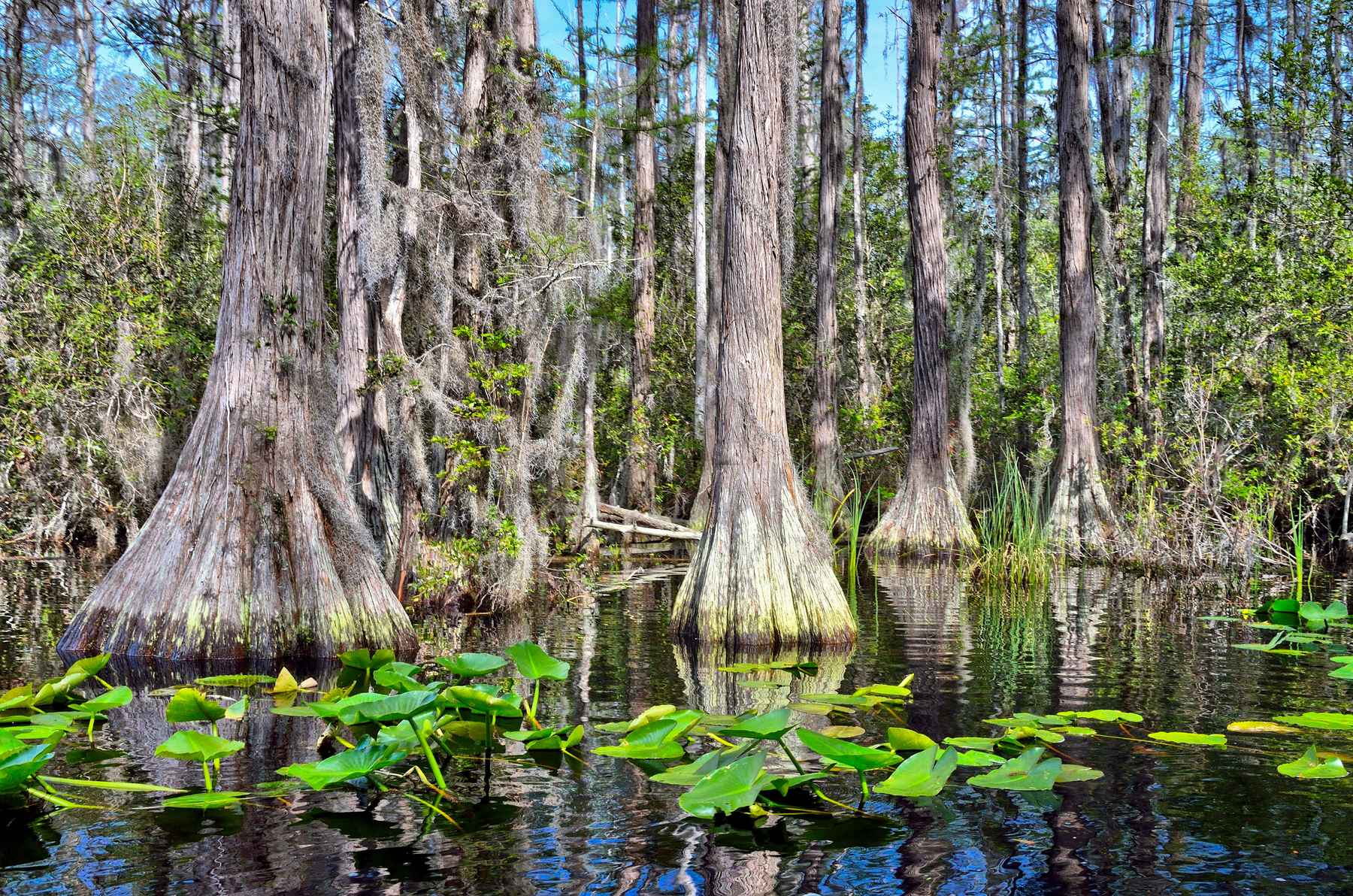
Just a year ago, the future of the largest American wilderness area east of the Mississippi River was in question, as biologists and conservationists feared that a dragline mining project on its southeastern fringes would tragically lower the water table and change the Okefenokee Swamp forever. After a land purchase last summer, and the formal transfer of the would-be mining site to the state of Georgia, the Okefenokee National Wildlife Refuge appears safe from industrial-grade development. Now, the wild refuge that straddles the Georgia-Florida border has become only the 13th natural site in the United States — and the first since 1995 — to gain UNESCO World Heritage Site status.
At a meeting of the UN’s UNESCO (United Nations Environmental, Scientific and Cultural Organization) committee meeting in Busan, South Korea, on July 25, the 440,000-acre peat-bottomed wetland and one of the most biologically diverse regions in North America earned its new lofty status after more than 40 years on the list of potential candidates.
“For years I’ve worked to protect Georgia’s beloved Okefenokee Swamp from dangerous strip mining, and now, following our bipartisan push, it’s been named Georgia’s first UNESCO World Heritage Site,” U.S. Sen. John Ossoff said. “The Okefenokee is an irreplaceable natural treasure in our state, and this significant designation will help protect this renowned natural treasure for generations to come, promote tourism, and support Southeast Georgia’s economic growth.”
Ossoff, a Democrat, was joined by Gov. Brian Kemp, a Republican, in praise of the refuge’s new status, which doesn’t transfer any ownership or management of the swamp away from the U.S. Fish and Wildlife Service that has managed this wild swath of the Southeast since it was first protected by President Franklin D. Roosevelt in 1937. “For generations, Georgians have enjoyed all that the Okefenokee National Wildlife Refuge has to offer as a valued natural treasure,” Kemp said in a statement. “An important part of our state’s heritage and economy, this is a fitting recognition for the Okefenokee that will further strengthen rural communities that surround it.”
For nature lovers, the swamp offers touchable access to some of the wildest country in America. Its waters are available for small-motor boating, kayaking and canoeing. It’s home to an incredibly rich wildlife tapestry that includes charismatic creatures like alligators, otters, and black bears, but is also home to rare red cockaded woodpeckers, sandhill cranes, white-tailed deer, rare eastern indigo snakes, and wild turkeys. It’s also home to 18 species of carnivorous plants.
For anglers, though, the Okefenokee offers a sneaky-good fishery for chain pickerel and predatory bowfin, a prehistoric airbreather that’s particularly rewarding for fly fishers willing to brave the gators that swim seemingly everywhere inside the refuges borders. This fishery is quite unique, and offers something different from the usual black bass and panfish angling that’s much more common in the Southeast.
As a part of the local committee that’s been pushing for full UNESCO designation since the early 1980s, Kim Bednarek, executive director of Okefenokee Swamp Park and Adventures, delivered an acceptance speech at the meeting in Korea on Saturday. “The Okefenokee is a place where nature still reigns,” she said. “Across more than 400,000 acres, water, fire, peat and time continue to shape an intact wetland, reminding us that conservation is about protecting the natural systems that sustain life itself.”
Just a few years ago, however, the swamp’s physical future was in question, as an Alabama-based mining company wanted to build a dragline mine to scrape away the surface of the land along Trail Ridge to get at the titanium and zirconium that’s found in the heavy sands found beneath the swamp. The mining effort would have produced 1.5 million gallons of water a day at the site, and biologists, hydrologists, and conservationists have worried for years that such a mine would alter the water table and forever change the swamp.
The Okefenokee serves as a giant natural rain barrel that’s kept within its boundaries by giant sand berms like Trail Ridge. It collects rainwater from about 600 square miles of south Georgia and north Florida, and it serves at the source of two storied American rivers — the St. Marys and Suwanee. Just last year, The Conservation Fund purchased the prospective mine site for $60 million to stop the potentially devastating industrial activity. Earlier this year, the state of Georgia acquired the mining site from The Conservation Fund for just $7 million, and is managing it as a state wildlife management area. The purchase and eventual transfer put to bed the risk of dragline mining within just a few kilometers of the Okefenokee National Wildlife Refuge.
While management of the refuge won’t change, a 2024 report by The Conservation Fund predicted that formal UNESCO World Heritage Site designation will contribute significantly to the local economy of Ware and Charlton counties where the refuge is located.
“Tourism is already growing at 4 percent annually,” the report reads. “World Heritage may increase this rate to 6 percent or 8 percent. If the bid to designate the Okefenokee as a World Heritage Site is successful, the region can expect the number of visits to double to 1.4 million or 1.6 million visits by 2035.”
Presently, the refuge sees about 800,000 visitors a year, making it a clear economic driver in the region. According to the report, the region stands to gain 700 new jobs as an indirect result of the UNESCO designation, and the area’s economic output could jump to $140 million annually — a 1- to 2-percent increase in regional GDP.
“Because of the ripple effects, the regional economy is likely to benefit beyond the tourism sector,” the report reads. “World Heritage would boost related industries and spending by employees of businesses that provide products and services to tourists. While harder to measure, quality of life is also likely to improve, with benefits for small businesses and business recruitment.”
In all, there are 27 UNESCO World Heritage sites in the U.S — 13 natural sites that include the likes of Yosemite and Yellowstone national parks, 13-cultural sites that include Mesa Verde National Park and the Statue of Liberty, and one mixed site (the Papahānaumokuākea Marine National Monument in Hawaii).
Trending Products