Some think of streamer anglers as the “nose tackles” of fly fishing. Short on finesse, these bestial trout hunters use heavy rods, sinking lines, and flies that cast about as well as a dirty diaper, all in the name of fooling big trout, immovable muskies, or massive king salmon in moving water.
And, generally speaking, that’s not too far from the truth. The streamer angler might be the construction worker, the backhoe driver, or the lumberjack in the perceived fly-fishing hierarchy. Regardless, just as in construction, heavy machinery operation, and felling tall trees, a spot-on technique matters. Good streamer anglers don’t often sway too far from the fly-casting basics. The tools used to cast a heavy conehead Dalai Llama (or Dolly Lama, or Dalai Lama — every fly shop seems to list the heavy, rabbit-strip steamer pattern under a slightly different name) might look like they require a bit of heavy lifting, but, in reality, they’re just branches off the general fly-casting tree.
Getting the timing down is the first challenge. Most fly casters understand that the weight we use to get our flies from Point A to Point B is the fly line, not the fly. After all, a fly rod is technically classified as a third-class lever — the cork is the fulcrum, the kinetic energy comes from the angler, and the load is the line. Streamer anglers can make the load look effortless, even when it’s enhanced with a heavily weighted fly that isn’t meant to perform during the cast, but rather after the delivery, when it’s in the water.
I’ve become a better streamer angler in recent years, but that’s largely out of necessity. If you’re going to cast a weighted line and a fly that, should it nail you in the back of the head on an errant cast, might leave an exit wound between your eyes, you best be reasonably proficient at the task. Still, most of us have managed to incur that self-induced knot on the back of our heads. Some of us have earned pierced ears, punctures, tears, and the like from hook-bearing streamers coming at us with the energy only a stout 8-weight can produce. So, as they say, practice counts, because it pays off when it’s game time—in more ways than one.
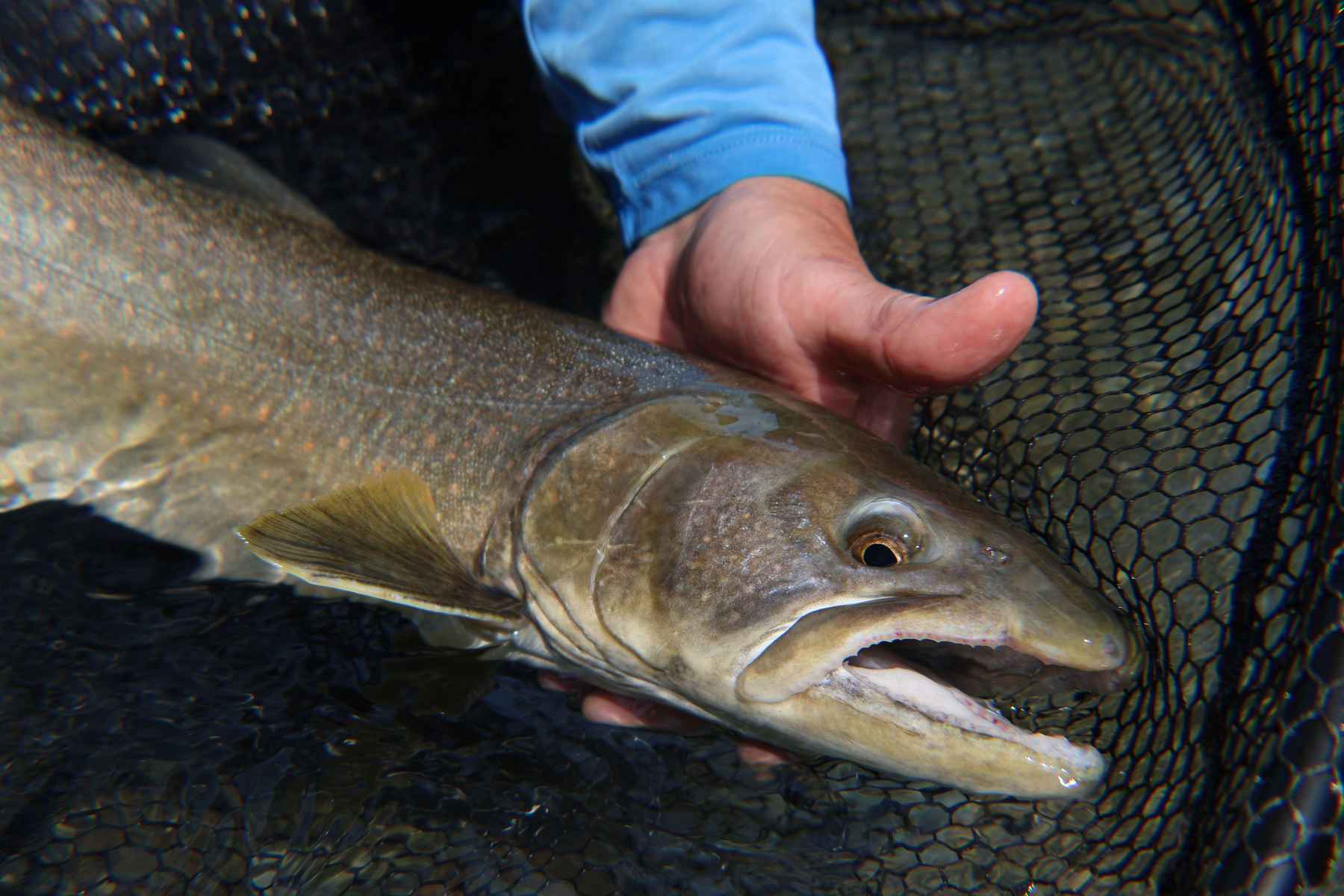
I spent a few days traipsing around the Cariboo Mountains north of the border recently, and the name of the game was streamer fishing. Big DLs (you figure out the spelling), sink-tip lines, heavy rods. And heavy water, too — the kind of backcountry boils that churn and spin and scour rivers down to the bedrock. This is where big, migratory bull trout run up the murky rivers of central BC every summer and spread out over thousands of kilometers of cold, clear tributaries as they prepare to spawn. Unlike salmon, and, to a lesser extent, steelhead, bull trout never lose perspective. Even as they migrate, they eat. God bless them for that.
Not unlike the rivers that careen off the Andes or the Southern Alps, the waters of British Columbia always seem to be in a hurry. Even the deeper, slower rivers are still constantly moving, and for anglers hoping to connect with these migratory behemoths, they first must get their massive flies from the fly box to the bottom of the river’s deepest waters where bull trout (and brown trout and salmon elsewhere in the world) tend to stage between spurts of actually migrating. And, more often than not, that oft-preached “upstream mend” isn’t quite enough to put a fly in the zone.
Enter the ‘flutter’
I learned this technique in Patagonia, and I learned it from, of all unlikely teachers, a die-hard tenkara angler who had a rod for every occasion. This guy eschewed the fly reel, and would fish the delicate Japanese fly rods in big water with traditional streamers. When I first watched him “cast” the long, telescoping rod, I was impressed by two things: first, he was dead solid accurate with this fly, even a big, unwieldy streamer. And second, he achieved maximum depth. After considering it for a bit, the latter turned out to be a simple endeavor—with a slim level line and no fly line to slow the fly’s trip to the bottom, his heavy streamers did what we all want our heavy streamers to do. They sank. It was simple algebra even an English major could grasp. With virtually no resistance, his flies got into “the zone” and they got there fast.
For traditional fly casters — even those brave souls who risk daily concussions from errantly cast, bullet-head Zonkers — getting the fly down in water that’s really moving can be very difficult.
On this particular trip, I was welcomed by some of the most impressive streamer water I’ve ever seen. At the same time, it took me a bit to figure out how to fish it best. That’s when I remembered my tenkara sensei. Accuracy and depth.
So standing at the tail end of a deep run that gets a bit skinny toward its end I dispatched with the notion that a cross-river swing was going to get my streamer down where it needed to go. And, since I couldn’t suddenly turn a 9-foot, 7-weight fly rod into a 14-foot tenkara implement, I did the next best thing. I peeled about twice the line I’d need off the reel, and worked to make a really accurate cast upstream to the head of the pool, where the water is deepest, but still pretty turbid. This took about half my fly line.
Then, to emphasize the need for depth, I cast the remainder of my fly line into an upstream belly, which immediately reduced the resistance on the fly. Yes, it was, technically, an upstream mend — but it was an upstream mend on steroids. Because the water was virtually gin-clear, I could watch the white and olive rabbit-stip streamer kind of flutter to the depths and start to move at the speed of the river. It took a few strips to recover the extra fly line and come tight to the fly, but when I did, the fly was in “the zone” where the olive-backed and virtually impossible to see bull trout were holding. Often, I just needed one strip to turn a fluttering, struggling “baitfish” into an actively retreating rainbow trout or whitefish. For predatory fish, sometimes this is all it takes. Bull trout are true predators, and they don’t like it when their food gets away. Even as the current grabbed the top half of the fly line and started to pull the streamer with some real gusto downstream with the current, I watched as one of the hungry char would leave the bottom and give a spirited chase downriver.
This isn’t a new technique. I would argue, though, that, because fly fishers like to be active and engaged with their fishing, it’s not a “go-to” method for most streamer anglers. Truth be told, it’s a very water-specific move — something done out of necessity. And some streamer junkies are, at their roots, no different dry-fly aficionados — such a move might be considered a violation of some code of ethics, like (God forbid) nymphing (and a case could be made that the “flutter” is a nymphing move).
And, dare I say, it requires a bit of finesse, which is something not associated with most streamer anglers. Nevertheless, every good streamer should have this move in their repertoire.
Trending Products